
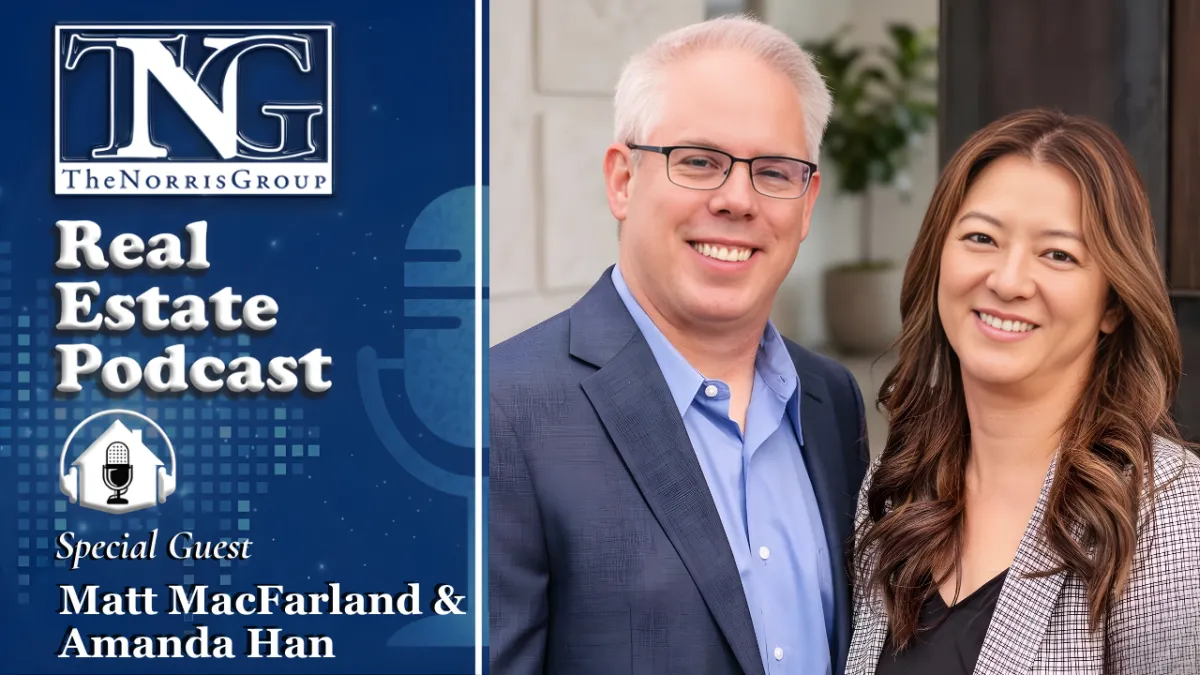
Inside Real Estate Tax Planning with Amanda Han & Matt MacFarland | Part 2 #951
In Part 2 of The Norris Group Real Estate Podcast, host Joey Romero continues the conversation with Keystone CPA managing partners Amanda Han and Matt MacFarland.
They break down powerful tax strategies for real estate investors, explaining why tax planning should be a forward-looking strategy rather than just filing returns. The discussion explores how investors can use deductions, entity structuring, cost segregation, and evolving tax strategies as they scale their portfolios.
The guests also discuss the growing role of artificial intelligence in tax research, emphasizing that while AI can assist with research and preparation, investors still need professional expertise to verify information and build personalized strategies. Through real-world success stories, they illustrate how strategic tax planning can dramatically reduce tax liabilities—even for clients with large windfalls or extensive real estate portfolios.
Amanda Han and Matthew MacFarland are CPAs and Managing Directors with more than two decades of experience in tax planning and advisory for real estate investors and high-net-worth individuals. Amanda, a UNLV graduate and seasoned real estate investor, is the author of several bestselling tax strategy books and has shared her expertise on platforms including Money Magazine, Google Talks, and CNBC. Matt, who earned his accounting degree from UCLA and a Master’s in Taxation from USC, is the author of The Book on Advanced Tax Strategies for Real Estate Investors and a frequent speaker on real estate tax planning. Together, they help investors build wealth through proactive and strategic tax planning.
RADIO SHOW EPISODE
In This Episode
Why tax planning should start before the tax year begins, not when filing returns
How real estate investors can maximize deductions and overlooked expenses
The right time to consider cost segregation and entity restructuring
How AI tools are changing tax research—and why investors still need expert CPAs
Strategies investors can use to scale portfolios while minimizing taxes
Real stories of clients paying little to no taxes through strategic planning
Advice on teaching financial literacy and investing to children
The mission behind Animals for Armed Forces Foundation
Episode
Narrator
Announcer, welcome to the Norris group real estate podcast, a show committed to bringing you insights from thought leaders shaping the real estate industry. In each episode, we'll dive into conversations with industry experts and local insiders, all aimed at helping you thrive in an ever changing real estate market continuing the legacy that Bruce Norris created, sharing valuable knowledge and empowering you on your real estate journey, whether you're a seasoned pro or a newcomer. This is your go to source for insider tips, market trends and success strategies. Here's your host, Craig Evans,
Joey Romero
welcome back to part two of our interview with Matt and Amanda, managing partners of Keystone TPA. Hope you enjoy. People who are in the game and experience will will know that, hey, tax strategies are something that that I can use to build my wealth now for newer investors, what are you guys doing to promote like, hey, it's not just filing your taxes. This is a tool to build your wealth, especially if they're going to start young. Like, so what are you guys doing to to promote the business?
Amanda Han
Yeah, it's interesting, because the best way we can do it is just to educate, you know, educate the public on it. We've written two books on tax strategies for real estate investors that helps you know the everyday person who wanted to read a book and learn about it themselves and understand there are things that could be done. We speak very frequently on live events and podcasts, and I have a social media account on Instagram where every day, you know, we're teaching people the different things they could consider to save on taxes, but it it's sort of a uphill battle a lot, because this is a funny thing, because we spoke at an event just a couple weeks ago on stage, we talked specifically about tax planning and how important it is when you get off the stage, people grabbed us and said, Hey, can you file my tax returns? We did not
talk about tax No,
Amanda Han
And I think that most people always think like, gosh, I just need somebody better to file my tax returns. The reason I'm paying too much is because my CPA, who's following my returns, is not doing all of the strategies, but really important for all of us to understand that there are no strategies when we talk about the past, the strategy and the word planning is always forward looking. So if you're complaining that your tax person didn't help you for last year's taxes, it's you're not looking at it correctly. The question to ask yourself is, who is helping me to plan now to save taxes on 2026 that's what planning is about. Alright?
Joey Romero
So I'm going to shift to thing that we've alluded to a couple of times now is artificial intelligence. It's touching every part of our life, and so it's going to touch every every segment. Now, a lot of investors are starting to use it to look at deals, analyze where to allocate funds, things like that. How much do you guys advocate them using AI for for what and what are you guys still like? Why should people still hire the CPA?
Amanda Han
It's interesting. We use AI pretty heavily in our firm, from, you know, drafting emails, marketing sales and also on tax research. But a very important role that we have for our team is for all tax research we do using and then for us, it's not Chatgpt. We have, you know, paid AI specific to taxes, because Chatgpt.is terrible for that. It hallucinates and makes up fake information. But even for our team, internally, it's we, we are required to take a step further. So for us, AI is step one of guiding us to where we should actually go to see case law as well as regulations and things like that. But it's not the end of the research, and I just think so. I think for the average listener, it's fine to use AI, but that is not your CPA. AI's output is only as good as the information you give it, and specifically for taxes, because it is always changing a lot of times. What chat GPT gives you is outdated information as well. So use it as a tool, but don't
Joey Romero
that's what I was going to say, is like, do you guys? Do you guys recommend to people like say, hey, use, use, use, AI to prepare you for our meeting where we're going to really dive into the strategies and planning. Do you guys recommend that for investors?
Amanda Han
I typically tell people, if you are a client, so all of our clients you know have access to us for consulting. I always tell people. All because you've hired us, you should just ask us the questions. That way we give you the right answers. We do have clients who ask AI to prepare questions that they send us. Sometimes it's helpful. Sometimes it's kind of, you know, AI stuff, right? Like you asked me 20 Questions, 10 of which are, are, you know, maybe 18 of which are not really relevant. Yeah, so we probably shouldn't talk about it, but we could
Matt MacFarland
if you wanted to. Yeah, I actually, I actually talked to a client this morning who did this exact situation. So she's got a transaction coming up, and she admittedly doesn't understand the entire transaction. So she, she kind of, you know, spit what she knew into into AI, and it came back with 15 questions and categorize areas to ask us. And I got the email, I was like, Well, this is pretty, pretty, you know, this looks like it was written by a lawyer or something, right? It was written by chat GBT, because she's like, what questions I need to ask? And so I think it's good from that perspective, to help you kind of get a better understanding of what's going on. But certainly it's not the end all to be all, and some of those questions in her situation, too weren't even applicable but, but it definitely can help you wrap your hands around what's going on sometimes.
Joey Romero
Have you seen people get in trouble because they rely too heavily on AI?
Amanda Han
We have, you know, one of the things that AI does fairly well is to kiss up to,
Joey Romero
oh no, my, I think some of the greatest thing
Matt MacFarland
that ever happened. Yeah,
Amanda Han
we have seen clients who have business ideas that they put into AI, and it kind of leads them down this path of like, this is just the most amazing. So, yeah. So part of our job is to gently discuss the holes that are within that business plan.
Matt MacFarland
And I think, I think, don't assume that it's going to be correct and make it better every time. So we were prime example. We were using it recently for a webinar which helped with some of the marketing tweaks. And it was, how can we improve the the click rate on this email? And it was strong. I mean, it was like, adamant. Like, here, this is what you should do. This is how you should reword the email. The click rate changed very miniscule. And I was like, hey, well, I want to go back to chat GPT and like, Hey, you blew it,
Amanda Han
I think specifically on the tax side. Just, you know, for everyone to know, again, it's okay if you use chat GPT, but you always have to verify. You know, some, sometimes we've experienced this in our form where we ask it a question. It'll give you very seemingly accurate citations of court cases down to the case number, and then we find out there's no such case, right? So yes, what is this about? Say, Oh, I'm sorry that here's the right case number, and then it's like, oh, that's actually also not a case, you know? So it's that kind of back and forth. So just verify that the case is actually a case, and then read the case does actually mimic my situation enough where I can rely on it.
Joey Romero
I actually spoke at the at the event for the first time on stage, and so my my section was how AI is going to affect real estate. And one of the one of the things that through all the books I've read because of all the walking I've done is, you know, I've just read a ton of books, and like my you see my favorite book behind me, that's the AI driven leader. And so I'm actually going to shift my presentation to be the AI leveraged investor. And so it's just using, using it for what it's actually designed to do, to make you better, quicker decisions, but you have to stay the human in the room. And one of the things from one of the books that I read was there's four things that you always do. You know, bring AI to the table. Assume that a this AI that you're using is the worst AI that you're ever gonna have. The third one was, tell AI exactly what it is. Be my thought partner help me analyze this. And then the last one, and the biggest one we just talked about, is always be the human in the room, so that, I love that. So now that we got, gotten into a couple of those things, let's, let's talk about more of investor level strategies, right? So it's really, that's the really helpful perspective, because ultimately, technology can help investors but stay informed. But strategy is the most important thing that you're going to bring to the table. So for someone who's buying their first rental property, what tax strategies should they be thinking about right away?
Amanda Han
Someone buying their first rental property, we kind of mentioned entity structuring right make sure you have the right entity, whether it's an LLC partnership, single member LLC, for new investors, I think really important to make sure you take some time to understand the deductions you're able to take advantage of. For a lot of those folks, it's
Joey Romero
what's the most commonly missed. Deductions?
Amanda Han
Oh, so many. Yeah, I think we're all pretty good about writing off mortgage interest in property taxes.
Matt MacFarland
Yeah, I think most people, they don't. They capture all that stuff that's tied to the properties that the interest of property tax and insurance. It's all those overhead costs of being an investor, being a business owner, that a lot of people forget about. So believe it or not, dues and subscriptions, going to real estate, conferences, travel expenses, meals is a big one that gets overlooked a lot. I think people don't realize that if you have a meal with somebody else, and you're talking about business right before, during or right after that meal can become a tax deductible expense. And so I think things like that, home office expenses isn't a big one, car expenses, all those things that are we're all spending money on already. It's just people don't realize that, hey, now I can transfer that from being a non deductible personal expense into a legitimate business deduction, because it is tied to my real estate investing is tied to my business, whatnot. So I think that's where people miss out a lot a lot
Joey Romero
of times, investors, especially the ones that have followed us for 1020, 30 years. You know, with Bruce and his following investing hasn't been the same the whole time. So does how important is that their tax strategy also evolve with their pivots in their careers.
Amanda Han
Oh, for sure, as you know, when you're a new investor versus when you're looking to scale, right? So we talked about, okay, first time investor, understand your write off scale and the right structures as you're looking to scale, then we're looking at tax efficient ways to scale. So is it a 1031 exchange? If I no longer want to own this property, I 1031 and keep doing so, right? What we call dropping? What is it that we call drop a swap?
Matt MacFarland
No, we call it something the 1031 until you pass away. Oh, swap, until you draw. I. Going to
Amanda Han
drop until you drop, right? I'm going to keep scaling from a single family, single family, to multi family, and then just keep doing it and pass it to my kids and grandkids with no tax. Or is it, if we're going to sell and we don't want to attend 31 how do we offset the game strategically, through other strategies, or do we do tax free profit extraction or equity extraction to then take the, you know, from this property to three more rental properties. So those are a little bit different when you're in the scaling phases. And, of course, at the very end, when you're in the ISO phases, it's more about generational planning. How much, what do I want to do with my assets? Because we have clients who are like, you know, I, I'm the one doing real estate. My spouse is not, does not do anything at all. I would hate to leave my spouse with a bunch of real estate that she will have to handle by herself if I'm gone, right? We don't all, yeah, what are all the different strategies and considerations around that aspect of it?
Matt MacFarland
And I think another way to look at it too is depends on where you're at, whether you're scaling or not, depends on where you're at in the journey. You might be the point where, a time where I don't want to own a bunch of rental houses anymore, I want to be more hands off. And so it gets to a point where you're investing in syndications and things like that, other people's deals, and there's a different strategy involved in that. And how do we utilize that, versus my own direct on real estate. So depending on where you are in your journey and what your goals are, is significant to dictate this tax strategy, but it certainly needs to be evolving as you move along in your journey.
Joey Romero
But that was one of the questions I was about to ask, is that at what point does it make sense for them to really get serious about cost segregation or restructuring their entities?
Amanda Han
Yeah, well, that differs from person to person, right? If you have you could have a very young person in the beginning part of their journey with very high income, and they buy a short term rental Well, we probably want to do cost segregation now, because we're going to wipe out the taxable income right from that source. You could have someone who owns a lot of rental properties, and all of their income is already naturally offset by regular depreciation, in which case I probably just do regular depreciation if I don't need all that much in terms of losses. Currently, you
Matt MacFarland
could have somebody that's on the tail end of their working years and they're naturally thinking, Well, I don't need to continue investing real estate. What's the benefit going to be? I'm not going to have my high w2 income anymore, but those might be the prime years where we're utilizing real estate losses to do tax free conversions of our retirement accounts, move that money from that tax deferred bucket, did a tax free bucket without having to pay a lot of taxes. So definitely depends on where they again, where they're at in their journey, where they're at in their goals. But it's that's why we enjoy doing this because it's fun. It's always something something new,
Amanda Han
and there's like, tax planning is different from person to person, because we've had this before where there's two partners, like, Well, I'm just gonna pay you for planning, because my partner is basically the same as me. You know, we all the same partnership with rental properties. But I tell them, No, you're not the same. You have different. Goals. You know, your spouses have different goals. You have other different things going on outside of this joint party.
Matt MacFarland
Your spouses have specific goals for you that you don't know about, and they are different, yeah, and they're right.
Joey Romero
They're absolutely right. Remember, yes,
Matt MacFarland
absolutely, absolutely now he's adding absolutely okay.
Joey Romero
Yes, what's your biggest success story? Or what's the most you guys have ever been able to help people avoid in in giving back to to old Uncle Sam, what's, what's, what's, what's one of your what's one of your favorite stories?
Amanda Han
Oh my gosh, there's so many. I mean, we because our clients are fairly heavy in real estate. Just over the years, we have a lot of clients who make over six figures a year and pay no taxes. I for us, that's fairly common. But again, because real our clients are so heavily involved in real estate, probably a more fun story might be. One of our clients last year was the winner of the Beast games. He won $10 million on the game show. Oh, wow. And it's been, yeah, it's been fun to help him strategize on different ways to offset the taxes on a windfall, you know, kind of a one time windfall like that, through, you know,
Joey Romero
get the whole time.
Amanda Han
Yeah, it's funny, because he was interviewed on a podcast, and they said, Hey, set aside $5 million for taxes, you know, on a minimum. And so, yeah, so there's different things like that, a little bit outside of real estate that's unique. But real estate for us is the easy stuff.
Joey Romero
For those that don't know, miss the beast games is from Mr. Beast. He's one of the biggest, if not the biggest, YouTuber out there, and he just has these really fun challenges where I've seen, you know, hey, last person to take their hand off this car. Wins the car. And it's like, literally, like, days, you know, going through all that. So it's, it's pretty fun.
Matt MacFarland
Matt, I think one, one that I thought of was we had a little bit of both sides of the spectrum. So we had a we've learned in our experience that a lot of people are afraid of virus audits, and they're they're always asking questions like, hey, is this going to get me audited? But in reality, what we've seen a lot of times that people get audited for, like, the little stupid things. It's the you forgot to report a w2 on your tax return. You forgot to do this or that some tax form 1099 is missing from your return. So we actually had a client get audit, a pretty big client get audited because the spouse and forgot about that part time job that they had in the summertime. And while the IRS is there, was like, well, this person has a lot of real estate, maybe we should look at this. And so that was a learning perspective, right? But at the end of the day that the success story of it was that we helped him plan for this audit. We organized everything, and once the IRS got involved and saw that everything was pretty organized and detailed, they actually ended up closing the case really pretty quickly in our eyes. And so, I mean, we, I'm pretty sure we screamed some expletives out loud at the office when we found out that the case was closed because he did cost SEC he did this, and not that he was doing anything wrong, but it was, there's something there that they could look at if they wanted to right, but for them, right, yeah, something to get out of there with a no change audit was a huge win for in that, in that situation,
Amanda Han
yeah, this was one that, I mean, an audit like for that specific client is probably something that takes five years or more Just because of how many properties, entities. And, you know, it could have been a very time intensive thing, even if we won the audit. So they
Matt MacFarland
could have opened up, you know, open up partnerships they were involved in, you know, it's Yeah.
Amanda Han
So it was very happy that if they closed it, because they said, everything you you provided, was amazing. I'm not going to waste my time.
Matt MacFarland
There might have been a celebratory drink on a weekday at like 11am in the office, possibly,
Joey Romero
I think you know, what's your what's your guys's under Subject line that you know, Keystone.
Matt MacFarland
CPA, oh, tax planning made easy.
Joey Romero
Yeah, you should be like, we'll keep you out of jail. All right, I want to ask just a couple of fun questions. I played baseball for a long time. I still coach baseball, Matt, a lot of you, I know a lot of your what you do revolves around baseball. And one of the things that I had with that I played at Rio Hondo junior college before I went on to the next school. John scolinos has a couple of viral kind of talks. One about the plate being 17 inches, you know, for everybody, right? And you don't expand it. But the other one he had was the eight lessons of life that baseball teaches you. What is the one thing that baseball has taught you, or that you implement in your everyday life that maybe crosses into business?
Matt MacFarland
I think something that baseball taught me early on is to. You want to be successful, you got to put in the work. I mean, this is going to be the case for any sport, but baseball, as we know especially, is those people that succeed 30% of time are Hall of Famers, right? So you're going to fail more times than you succeed in baseball. And if you want to get better, you got to put in the work to get better. And so I think that's something that stays with me every day is that, if we want this to be a better operating office, we want this to be better that way, we've got to work at it, right?
Joey Romero
So one of the things I tell my son and my kids is like, great hitters, hit a lot. You know, they get a lot of hits, but because they hit a lot, actually, I just thought of something else. Like, you guys are both parents. How early should parents be really talking about not just what they're learning in school, but real life applications, talking about economics and, you know, things like that. How early are you guys talking about? Like, let's say some, some of these things that you guys are teaching, you know, the most experienced relative to state investors. How much that do you guys apply to your kids? Like, for me, it's as soon as they get any kind of money or anything like they're buying houses, all my kids are all going to buy houses immediately. So what are you guys going to impart to your kids?
Amanda Han
Well, and I think, you know, from a for I think for us, teaching is sort of worked into everyday life, you know, not like just teachable moments all the time, right? We talk pretty frequently about work related matters at home, and the kids are exposed to it. So in that, it's discussions about client issues, client opportunities issues, with our team member, you know, growth issues and so for them, it's kind of peripherally. They're listening. Our older one, who's now 14, he will chime in and ask questions. Mason is, yeah, he's seven, so he doesn't really understand too much of it. But yeah, we, I can definitely see our teenagers more interested. You know, he was like, why? What happened here? What happened to that team member. And I think for me, that's super helpful, because I grew up in a family of entrepreneurs. My grandparents were entrepreneurs, my parents are entrepreneurs, and I've always been around that. And I think that's the kind of stuff that's really priceless, right? Just having them be around it and exposed to it, not that there's any to do or action items at the time, but that they understand that's what happens in the real world in business.
Joey Romero
So you're turning everyday work experience to teachable moments for your kids,
Amanda Han
yeah, yeah. Or sometimes Yeah, when they get money, you know, we talk about, we talk about investing it, or
Joey Romero
saving, investing? Yeah, absolutely. So Amanda, you know
Matt MacFarland
he's, he is, he is 14, so he talks kind of weird and weird way, like all these teenagers do these days. And so I'm not always sure he's actually serious when he's asking the questions or just trying
Joey Romero
to irritate me. You guys, bro, bro. Oh, yeah. Oh well, not
Matt MacFarland
me, but yeah, it's, yeah, you don't even
Joey Romero
want us, bro. And it's giving. It's giving.
Matt MacFarland
I'm Dad. Thank you. The what's
Amanda Han
really interesting, I think our 14 year old has learned is that he's all about saving and investing. So all of his money goes to saving and investing, but when he wants something that is our money, yeah, oh, because your parents, you have to pay for these things. You know, they're just clothes. I need them.
Matt MacFarland
I'm hungry every two hours. You should be buying me food every two hours.
Yeah. So the difference is, my money is mine and your money.
Joey Romero
So speaking about learning food, Amanda, one of the things that your bio is like you love looking for those hole in the wall. Now, I don't tip I don't want to live in San Diego, but I love going down there to so what's your favorite place to favorite spot to go eat in San Diego?
Amanda Han
In San Diego? Oh my gosh. Have to think. I feel like we don't go to San Diego too much.
Matt MacFarland
We did take the kids to, was it we were down there over in Christmas time, and we were celebrating our anniversary with our kids, and so we took them to Ruth Chris Steakhouse. And obviously, Ruth Chris is very good,
not a hole in the wall, but just to clarify,
Matt MacFarland
trying to expose them to good, you know, good, nice restaurant where you can't act like a weirdo, and, you know, talk, you can't call the waiter bro.
Joey Romero
So, you know, Matt, you know, the reason I'm at the Norris group is because I spent so much time in the community with Aaron and so volunteering and, you know, just built up a friendship. And here, you know, so we've spent a lot of time giving back to the community and spending time with nonprofits. Now you've, you know, can you tell people about animals for armed forces?
Matt MacFarland
Yeah, so animals for armed forces Foundation is a organization that we founded. Been going on 1314, years ago. And the impetus was I used to actually volunteer at a local animal shelter. And so we were driving by, I think it was Veterans Day weekend. It was just kind of like, my dad was in the Navy, my stepdad was in the army. It was kind of like, hey, that'd be kind of cool to be able to provide an adoption event where the animals are free to adopt to military members or former military members. And so I took that, that idea, to the animal shelter later that year, and they loved it. And so we subsequently formed this foundation where we put on basically sponsored Pet Adoption events, where military members and their families can come down and adopt animals for free, and we cover the adoption fees. So going on 1314, years. We've had over, you know, 1000 animals adopted by military families. So it's pretty cool TV. I've been on TV a few times.
Amanda Han
They let you on TV. I thought it was always Amanda. She's the face of the No, she doesn't,
Matt MacFarland
she doesn't want to get up early for those TV segments at 530
Joey Romero
in the morning. Well, that's awesome, you know, because we're helping not only animals, but we're also helping veterans. Always grew up with dogs, but they were just kind of like there as like background noise growing up. But it wasn't until I married my my wife, that dogs truly are part of the family. And you know, I, like, in my, in my previous unmarried life, all the dogs were all outside, just like they whatever we would scraps. But now, like, I've all, I've only had inside dogs, you know.
Matt MacFarland
And now, now Joey. Now Joey is sleeping outside. Yes, yes.
Joey Romero
It's really cool that you found a way to help two, two different segments. So the last thing I'll say is, what's the one piece of advice that you would give real estate investors that are listening right now, that they can still do before they file? Or, let's say, to just start thinking about next year's tax buying?
Amanda Han
Gosh, well, I think it's kind of one of the same right before you file your tax returns, or when you're filing, make sure to request or book a separate appointment to meet with your tax person, to go over 2026 tax strategies, especially if you feel like you're paying too much on last year's taxes, but definitely do it as a separate meeting. You know, most accountants are really busy trying to meet the March and April deadline, and if you try to squeeze it in, you try to save money and say, Well, I'm already here. I'm going to talk to you. You're not going to bill me separately. You're just not going to get the level of planning that is really impactful. You know, because for planning purposes, like for us, we have a whole framework that we do in terms of we look at the overall financial well being of a specific person that that's, you know, their cash, their real estate, their stock portfolio, their retirement account, you know, what they plan to do with their money and their kids, and holistically, look at everything, and that's not going to be squeezed into a, you know, 10 minute conversation right before you sign on your tax returns.
Matt MacFarland
Yeah, I would say just make tax planning and the idea of thinking about it all the time something that's not an afterthought. It's something more of a forethought that you do actually think about I was just, we were talking to a client recently who was loved the way he was thinking about it, and it's he was okay, what worst case scenario? What's my tax going to be? And then let's, let's divide, devise a plan to bring that down to a number that I'm comfortable with. And I think that's what people forget about, is they just live their life and taxes come here, April 15, I pay it and I complain about and then we rinse and repeat next year, unfortunately. So make it up. Make it up forefront on your thought process,
Joey Romero
especially as tight margins can be in California, you know? So that's it's very important for sure. So guys, thank you so much. The last thing I'll give you is the opportunity to tell people how people can reach out to you and hire Keystone CPA.
Matt MacFarland
Yeah, I think the best place to find us is our website, which is Keystone cpa.com we have a lot of information on there, free resources. You know, we talked about real estate professional. You want more information, or, Hey, I don't know what that is. What is that you can find a lot of information our website and different services and how we can work together?
Amanda Han
Yeah, if you're trying to, if you want to know whether you might be overpaying in taxes, we do have a tax risk assessment. It's a free self assessment. Probably takes 30 seconds. You can visit our website for that, and you'll get emailed your score on how you did. If you're looking for daily tax tips, I mostly found on social media, on Instagram as Amanda, Han, CPA, and you know, our firm does tax planning as well as tax return filing. However, we don't just have clients come to us only for tax return filing, so we have capacity to help people for 2026 with planning and future tax return. But don't call us if you're just like, I need someone to file my taxes for last year.
Joey Romero
And is it just California? Are you guys nationwide?
Matt MacFarland
No, we have clients all over the country, so I can't say with any certainty that we. Cover all 50 states, but we do cover a lot of those,
Joey Romero
maybe all 50 Well, guys, thank you so much. You guys are always so generous with with everything. The Norwich group really appreciate and appreciate you guys jumping on with us today. So with that, we're gonna sign off everybody. Thank you so much for listening, and we'll link all the stuff in the in the show notes for you guys that make it easier to find out. Matt and Amanda, thanks guys
Narrator
for more information on hard money loans, trust deed investing and upcoming events with the Norris group. Check out the norrisgroup.com. For more information on passive investing through the DBL capital Real Estate Investment Fund, please visit DPL capital.com
Joey Romero
the Norris group originates and services loans in California and Florida under the California Dre license 01219911, Florida mortgage lender license 1577, and NMLS license 1623669, for more information on hard money lending. Go to the Norris group.com and click the hard money tab.


