
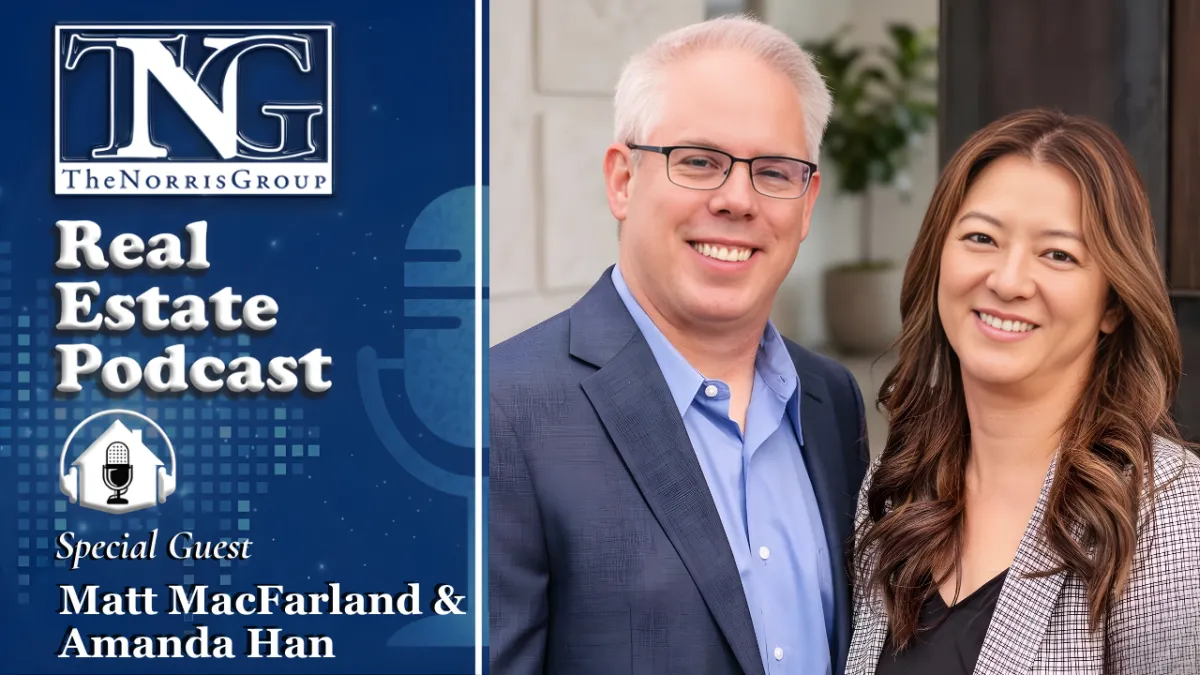
Inside Real Estate Tax Planning with Amanda Han & Matt MacFarland | Part 1 #950
In this episode, Joey Romero sits down with Matt MacFarland and Amanda Han of Keystone CPA to explore the tax strategies real estate investors need to know. From cost segregation and bonus depreciation to real estate professional status and the short-term rental loophole, the conversation breaks down complex tax concepts into practical insights. Matt and Amanda also share how they transitioned into working with real estate investors and why staying ahead of changing tax laws is critical for both CPAs and investors.
Amanda Han and Matthew MacFarland are CPAs and Managing Directors with more than two decades of experience in tax planning and advisory for real estate investors and high-net-worth individuals. Amanda, a UNLV graduate and seasoned real estate investor, is the author of several bestselling tax strategy books and has shared her expertise on platforms including Money Magazine, Google Talks, and CNBC. Matt, who earned his accounting degree from UCLA and a Master’s in Taxation from USC, is the author ofThe Book on Advanced Tax Strategies for Real Estate Investorsand a frequent speaker on real estate tax planning. Together, they help investors build wealth through proactive and strategic tax planning.
RADIO SHOW : Inside Real Estate Tax Planning with Amanda Han & Matt MacFarland | Part 1 #950
In this episode:
Joey welcomes Matt MacFarland and Amanda Han of Keystone CPA.
How Keystone CPA helps investors navigate tax strategy and long-term financial planning.
The journey from traditional accounting to specializing in real estate investor tax planning.
Common tax planning mistakes real estate investors make and how proactive strategies can improve outcomes.
Why CPAs must constantly adapt to evolving tax laws and industry changes.
How bonus depreciation affects cost segregation strategies for real estate investors.
A breakdown of the requirements for qualifying as a real estate professional, including material participation hours.
An explanation of the short-term rental loophole and how some investors use it for tax advantages.
Episode:
Narrator Welcome to The Norris Group real estate podcast, a show committed to bringing you insights from thought leaders shaping the real estate industry. In each episode, we'll dive into conversations with industry experts and local insiders, all aimed at helping you thrive in an ever-changing real estate market. continuing the legacy that Bruce Norris created, sharing valuable knowledge, and empowering you on your real estate journey. Whether you're a seasoned pro or a newcomer, this is your go-to source for insider tips, market trends and success strategies. Here's your host, Craig Evans.
Joey Romero Welcome everyone to The Norris Group Real Estate Podcast. We have a couple of tremendous guests, some old friends of ours, Matt and Amanda Han from Keystone CPA. Matt received his accounting degree from UCLA and a master's in taxation degree from USC as a CPA. Matt brings over two decades of tax planning expertise in working specifically with real estate investors and high net worth individuals with his experience in Big 4 Public Accounting and in private client advisory. Matt is an avid speaker and educator on real estate tax strategies, and authored the book on Advanced Tax Strategies for Real Estate Investors. Matt has a passion for animals and founded the Animals for Armed Forces Foundation. In his spare time, Matt loves all things baseball, coaching little league for his sons, watching baseball on TV, going to a local game, or just talking baseball with anyone who will listen. Amanda received her accounting degree from UNLV. As a CPA and real estate investor, Amanda has helped countless investors across the nation supercharge their wealth building through proactive tax savings with her top selling Amazon books as well as her teachings on prominent publications such as Money Magazine, Google talks and CNBC. Amanda brings over two decades of tax planning and compliance experience from working in Big 4 Public Accounting as well as public and private companies. In her spare time, Amanda enjoys canvas painting, biking by the beach and seeking out the best hole in the wall, dining options wherever she visits. Let's welcome Matt and Amanda. All right. Welcome everybody to The Norris Group Real Estate Podcast. We have some friends of ours. I don't want to say old, because when you say old friends like you're like, Hey, I'm not that old. They, they've been friends of The Norris Group for a long time. That's let me frame it that way. So today we have Matt and Amanda, of course. Thank you so much for joining us, guys.
Amanda Han Yeah, I'm excited to be here.
Matt MacFarland Oh, thanks Joey, of course. Good to see you.
Joey Romero Alright. So you know, there might be some folks that are brand new to our you know, to our audience, and it's been a couple years since you guys have been on a podcast or been at our event. So for the benefit of those that are living under a rock, can you tell us what Keystone CPA does and who you guys primarily work with?
Matt MacFarland Yeah, well, thanks for having us, our friend. Keystone, CPA, we specialize in working with real estate investors all over the country. We help them to proactively plan to save on taxes and use that tax savings to help continue building in their wealth.
Amanda Han Yep, I think most people come to us are folks who own real estate or plan to own real estate, but don't have a CPA who helps them to plan strategically on how to use real estate to not just build wealth but also save on taxes. And I think it's no secret that the tax law favors real estate investors, but the key missing ingredient that we see is just people not really understanding how to actually implement some of those strategies that to take advantage of the tax code. So we have a passion in sharing what those things are and educating people how they can do the same.
Matt MacFarland And as you stated, we are old, so we've been doing this a long time, so.
Joey Romero See? That was one of the things by pre recording your bio. I didn't have to sit there and say "Over two decades of experience".
Matt MacFarland Right.
Joey Romero So anyways, so what say somebody starts, you know, hires Keystone CPA, is talking to you guys, what is the biggest thing that they find out that they've been missing?
Amanda Han Gosh, it's, there's so many different things in the you know, the findings will differ from person to person. But what's really interesting is that, based on our experience when we start doing tax planning for a client, the first thing we do is look at the previous year's tax returns, right? Whether it's business, personal, real estate, and that's important, because it gives us a good understanding of what they've done in the past, what they own, but kind of just the overall detail of their finances. But the interesting thing is that over 40% of tax returns we review are not optimized for tax savings, so pretty high percentage, and it is from a lot of different things. Maybe not capturing expenses, maybe not being in the right legal entities, sometimes not optimizing depreciation, right? So a lot of different reasons as to why tax returns got optimalized.
Matt MacFarland I think from my end, the one that comes to my mind is, I think a lot of people don't, haven't done tax planning in the past. So a lot of people think that I've hired this CPA, this tax preparer, whoever they're following my returns, they're helping me do tax planning, right? Obviously, because they know my numbers. But in reality, what they're doing is, we all know they're doing is they're just following your returns and putting numbers on a form and representing what's already happened in the past. They're not actually helping you what's going forward. And so that's what we like to do, is we like to meet with clients. And hey, what are your goals? What are you trying to you trying to do? What can we put in place to help you save on taxes this year, coming forward next year, after that, that kind of thing.
Joey Romero That's the big proactive piece, right?
Matt MacFarland Right, right. For sure.
Amanda Han Yeah, we all file tax returns, you know. But I think the majority of Americans, including investors, don't actually do planning separately outside of let me get my tax returns.
Joey Romero Yeah, we're going to dive into all of that little bit later, but before we get into that, I want to just touch a little bit more about your background. So one of the big questions that maybe what is Big 4 Accounting?
Matt MacFarland So Big 4 Accounting is big six, I think when we, when I started, but big, but it's the large, multi kind of national CPA firms that work with clients all over the country. It's just the largest four CPA firms out there. So that's where we got our start, at one of those great experience out of college. Obviously, you get exposed to a lot of different industries and a lot of different types of taxpayers and things like that, so.
Joey Romero So what was it about working with real estate investors either made you guys pivot or drew you to working with real estate investors?
Amanda Han It's actually interesting because it's actually not that experience. So when we were working in one of the big four firms are, I was in the real estate specialty group, and Matt was in the high net worth individual group. And all that means is, you know, I worked on a lot of the largest real estate investment companies, and then he worked on the individuals who, you know, who were part owners of those. But doing that day in and day out, didn't really lead us to want to invest in real estate. I think, like many people, we were always of the thought that real estate was for people who are really wealthy. Tax Savings was really for the people who are wealthy. So for many years. I mean, we see the tax savings, we know the strategies, but we always thought those didn't apply to us. They apply to our clients, but never to us. And it wasn't until we read Robert Kiyosaki spoke, Rich Dad, Poor Dad. But we thought, You know what? That's stuff that average person can do, and so maybe that's something we can do as well for our own wealth building.
Matt MacFarland So I think for me...
Joey Romero Yeah, go ahead.
Matt MacFarland I was gonna say, I think for me, the big kind of, I call it the 'AHA!' moment, was when I was working the Big 4 Firm. I was probably a couple years in, and I was working on an individual's reviewing, an individual's tax return. He was in his 60s at that time and making over six figures in cash flow on his real estate, but not paying any taxes. And so that's when the light bulb went off. Is like, hey, there's something here. Like, let me get some of this guy's clearing, this guy's clearing hundreds of 1000s of dollars and not paying any income taxes. Like, so that's kind of when the light bulb went off and it was just, again, something we like and understand.
Joey Romero So, so you guys both came from those Big 4 companies. Like, what made you guys say, 'All right, let's take a leap. Let's start our own firm'. How did Keystone CPA come about?
Amanda Han It's actually interesting. When we first started getting interest in real estate, we didn't know that, we didn't know how to invest in real estate. We knew the tax strategies. We didn't know how to analyze deal. We didn't know where to find a good property. So we started going to a lot of real estate investment clubs locally, and that's where we met everyday investors. And what we found out was that everyday investors didn't actually do tax planning, all of stuff that we're so used to doing at our day job was not available to regular folks who invest in real estate. So that's what sparked our passion originally in that we wanted to bring those same strategies down to everyday investors to be able to do the same, basically take advantage of the tax code to leverage tax savings from owning rental real estate.
Joey Romero So clearly, you guys both have, you know, all those, all the credentials. People think that, oh, you become a CPA, like, I'm just a CPA for life. One of the reasons we weren't able to, you know, schedule this podcast for a while is because you guys are constantly having to learn. So as a CPA, you know, you never stopped learning because of all those changes. And what does it take to stay current as a CPA.
Matt MacFarland You're right. I mean, it definitely changes all the time. I mean, obviously with, you know, when you change administrations, you change governments, you know, new tax law comes out, there's those things to consider. But just as a CPA in general, we do have to get 80 continuing education hours every two years in the State of California, is where we are. So that's important there. But to we were talking earlier, right, with offline AI, the whole industry is changing everywhere, and so be able to stay on top of that. What's changing in the CPA industry because of that. What are some new software that people are using? What are some processes? I got a whole segment about that a business perspective, right? You got to stay on top of that. So, it's a, yeah, it's a lot of stuff, but it's keeps us on ourselves, for sure.
Joey Romero What is the biggest thing that other CPAs struggle with, that you're finding that, like, there's a reason why these people came to you?
Amanda Han Well, what's really interesting is that everybody gets their tax returns filed, but not many people actually do tax planning. That's from the taxpayer side. But when we go over to the CPA side, most CPAs file tax returns. That is what they deem to be their job. That's what clients hire them to do, because the need is to file tax returns, very few CPAs focus on tax planning. The reality is that especially with AI, there are not a lot of people who are graduating now who want to become an accountant, because there's a huge fear that AI is taking over the job of accountants, right? One of those that's easily replaceable, theoretically. And so you have a large population of people who are retiring, so taking them out of the workforce, and then now no additional folks coming to become CPAs. So the pool of CPAs are much smaller, so you have fewer CPAs to service all the tax return filing, which means even less time for a CPA to even think about tax planning for a specific client, because you're just back to back with filing tax returns. And that's the reason the majority of people come to us, not because they need a tax return file. They still do need someone to file it, but it's mainly, 'Hey, my CPA does not have time, knowledge or ability to give me tax strategy, so please help me out with at least the planning side'.
Matt MacFarland Yeah. And along those lines, I think it's the specialty aspect as well. A lot of CPAs taxpayers, whatever you want to call them...
Joey Romero ...secondly, then, right? Just like...
Matt MacFarland They're generalist, right? They file all kinds of tax returns. And we learned early on that, hey, real estate is something we understand, it's something we know. It's something we are passionate about, and some are good at. Let's focus on that. I don't we don't file manufacturers, tax insurance. We don't file retail companies tax insurance. I'm sure we could figure it out, but I don't know what I don't know, and I'd rather focus my energy on the stuff that I know.
Joey Romero So what are some of those telltale signs, or, let's say, red flags, that say I have a CPA, but what can working with him or her tell me that maybe my CPA isn't optimizing for my career and it's just giving me that general file?
Amanda Han Well, I think the first question would be, how frequently do you meet with your CPA?
Joey Romero It's great point.
Amanda Han Another question to ask yourself is, what is my plan? Can I describe, if you were talking to me, can you tell me what is your tax saving strategy? Is it buying rentals and what is our exit strategy with respect to my portfolio? How am I passing it on to the next generation? Am I eventually going to sell? Is my husband or wife going to take over if something happens to me? And I think another sign to look out for is whether you're someone who always has to explain your transactions to your accountant. Real estate investors, we don't feel it a lot, but there's a whole real estate lingo that we always talk in, and I think a lot of people find it frustrating when they talk to their accountant, not even just on the strategies, but taking a long time to explain and teach them what exactly they're doing in real estate and how they're currently structured. That's a sign of somebody who doesn't really understand real estate as a business.
Matt MacFarland Another way to look at it is, we like to joke, but it's true is that is your accountant talking to you more about what you can't do versus what you can do. So if you if you, if you want to spend more time about what can I do? Let's talk to somebody who is proactive and thinking of the future, you know, most people are looking at what you can't do, right?
Joey Romero Without getting into the whole AI piece, because I have a whole segment about that for you guys. What is the biggest tax law changes that investors should be looking for this year?
Amanda Han Well, there's several very major tax changes that came out of the One Big Beautiful Bill in July of 2025 and what's really great about that is most of the changes were retroactive, meaning available for the 2025 year, which are the tax returns people are now filing, as well as going forwardfor 2026, a couple of big ones with respect to real estate investors or real estate in general, is we have the ability to exclude, potentially up to 20% of real estate income from taxes under qualified business income deduction. That's not brand new, but the One Big Beautiful Bill allowed us to continue to have that tax benefit. So very helpful for landlords, because it is available for certain rental income, realtors on commission's income, property management income, also eligible for development, flipping, wholesaling, most of those real estate related income could be eligible. The easiest way to explain it is, if you have $100 worth of taxable rental income, maybe you only pay taxes on $80 of it, because $20 of it potentially tax free under qualified business income deduction.
Matt MacFarland Another one that, yeah, it's not brand new under One Big Beautiful Bill, but was extended and continued forward is the pass through entity tax break. So anybody that's got, you know, a lot of your listeners have realtors, right? They have a real estate business or wholesaling fix and flip something like that. If your entity is profitable and you are paying state income taxes at the personal level, you should be looking at having your entity pay those state taxes on your behalf, instead of you paying them personal funds. The benefit is now we can take a full deduction for it at the IRS level, whereas if you pay it with personal funds, a lot of times, that deduction is going to be limited. So it's a nice thing that, again, it's been around for 5, 6, 7, years, and it's been made permanent in One Big Beautiful Bill. But believe it or not, we still see it all the time that people are not taking advantage of this.
Amanda Han A very big benefit for California folks, because California state taxes is so high, and effectively, worse we're doing is we're turning up personal expense into a legitimate business deduction by having the business pay for it. And the last one, I would say for real estate, more real estate specific, obviously, 100% bonus depreciation.
Joey Romero Yeah, I was gonna ask, what's happening with bonus depreciation. Everybody wants to say, you're on.
Amanda Han It's really interesting, because if the One Big Beautiful Bill didn't pass, 2026 bonus depreciation was set to be at 20%. And now with the passage of the bill, it's back at 100% so it's effectively five times more powerful now than what it would have been. And so a very significant welcome for our clients who have bought real estate after January 19 of last year, putting them in service. And that also applies for construction and rehab as well. So even if you have an existing property that you've owned years ago, but now you're doing rehab, you're adding ADUs onto them, all of the new improvements you do are eligible for the new bonus depreciation goals as well.
Joey Romero Nice. So how does bonus depreciation tie into like, a strategy like cost segregation?
Matt MacFarland It is definitely a huge component of the cost segregation. So Cost Segregation is, for those people who don't know is it's a, we call it like a supercharged way of getting depreciation expense. You know, with our rental properties, we can depreciate a residential house over 27 a half years commercial building over 39 but with a cost seg study, which is basically like an engineering study. Somebody goes in and looks at that building and says, 'Hey, there's certain things in here that we can depreciate faster, like over five years or 15 years', which is crazy. That definitely helps. But then when you tack on bonus depreciation on top of it, those five and 15 year assets, instead of being written off over five or 15 years, now we can write it off on the first year. It's just, it's such a super, like I said, a supercharged way of getting depreciation. So with a good cost seg study on a new asset acquisition, it's not uncommon to see upwards of 20 or 30% of the building amount be depreciated in the first year. So you could buy a $500,000 property, maybe it's four, $400,000 as a building. Take 30% of that. That's 120 grand. That's your depreciation deduction in the first year with a cost seg study. That's, I mean, that's gonna move the needle for a lot of people.
Joey Romero Yeah, and especially if you have multiple properties, as you get it that far too, right?
Matt MacFarland For sure, for sure.
Joey Romero What's in the rumor mill? What's, what's the potential changes that are coming that you could see having a big impact for real estate investors?
Matt MacFarland Well, this is where we call Bruce. He predicts the future for us and...
Amanda Han Yeah.
Joey Romero He's retired, though.
Matt MacFarland He's not, no, I still have his number.
Amanda Han From a tax perspective, there's nothing major that is in the works at the moment. But I am of the opinion that if there are some significant changes to the economy, that's when we may hear additional tax incentives come out to try to boost the economy. And you know, but as of today, there hasn't been anything significant that we're tracking for real estate purposes.
Joey Romero Do you guys like the 2025, Big Beautiful Bill?
Amanda Han Yeah. I mean, from a purely from a tax perspective, right? We say the Big Beautiful Bill includes all kinds of non tax things as well, but purely from a tax perspective, from the eye of a business owner and real estate investor, a significantly beneficial, which was not a surprise, right? President's a real estate investor, so that part of it was very welcomed, I will say the One Big Beautiful Bill is one of the recent bills that has pretty major changes outside of business and real estate too. So there were brand new tax benefits in terms of tax free overtime, tax free tip income. So those you know brand new and that those are good for working folks who you know, make W-2 income that traditionally had very little tax benefits. We have the ability to write off more on our primary home property taxes and state income taxes that increase from 10,000 up to 40,000 for the threshold. And, you know, the ability to write off interest on a new personal vehicle assembled in the US, so a lot of different things that were positive from a tax statements perspective, even outside of the general real estate and business.
Joey Romero Yeah, and that's why I wanted to ask you about that, because, you know, there's a lot of, you know, political noise around it, but strictly from the tax and the real estate investor side, like, that's like, is it good for us? Then that's the answer that that we want to hear on, least on this podcast, right? So one of the things is, knowing the law and understanding the law is one thing, but implementing it, to be able to take advantage of it, is a whole another thing. And so can you talk to talk to our people about being a real estate professional and that status and how that's advantageous for them?
Matt MacFarland Yeah, for sure, real estate professional is definitely a great strategy to have in your in your toolbox, and to use it in the right way and at the right time. I think taking a step back for people to understand kind of from a tax perspective, when you own rental real estate, you can always deduct rental expenses against rental income. But the question comes up is, if your rental expenses exceed your rental income and you have a loss, what do we do with that loss? You know, can I use it to offset my other income? In a general sense, the IRS says if you make less than $150,000 a year, you can deduct some components of current year rental losses against your income. But if your income. But if your income is above 150 whether you're single or married, then in order to use rental losses to offset W-2, business income, interest dividends, generally speaking, if you're investing in long term rentals, you have to qualify as a real estate professional. Or if you have a spouse, your spouse has to qualify. So that's the benefit of is it allows you to maybe strategically create those losses on paper through a cost segregation study, and then use those losses to reduce your taxable income from your W-2 and other sources. That's the benefit. But there are certainly some requirements you got to meet.
Joey Romero Yeah. I was gonna say, yeah, I got a license. Am I a real estate professional now?
Amanda Han Yeah. I mean, usually for a real estate professional status a couple of different roles. One is you have to, the first one I'll describe as the hardest one for most people to me, which is you have to have more time in real estate than your job or non real estate businesses. And so if I'm someone who works full time at 2100 hours in my job, I have to have more than 2100 hours in real estate to be a real estate professional. So that's where we see the hurdle for it, if you are hiring a learner in your real estate, but if you have a job, it's difficult, if not impossible, to be a real estate professional. The other rule is you have to have at least 500 hours, generally speaking, on your rental properties. So that the tax term for this material participation, effectively you are involved in the in the day to day operations of your rental property. So what we see in practice is fairly difficult for somebody working full time to qualify. However, there is what we call the marriage tax loophole, which is that, if you're a high income learner, but you have a spouse who's maybe only working part time or not working a stay at home, then that person it would be much easier for that person to become a real estate professional, because they don't have to overcome, you know, job hours, if they're not working, then they just have to have at least 750 hours in real estate to be able to qualify as real estate professional.
Amanda Han So are you? Are your kids real estate professionals?
Amanda Han Well, that if your kids are real estate professionals, it doesn't actually help you on your tax return. It's going to be you or your spouse, but you know...
Matt MacFarland But yes, we're going to make them, we're going to turn them into them at some point.
Amanda Han But you you. Better believe that we get a lot of questions all the time from married folks who say, 'Hey, can you convince my spouse that I should stop working and being a real estate professional'. This is a daily occurrence. Communication, text messages.
Matt MacFarland So, we're in addition to CPAs, we're also marriage counselors.
Joey Romero Yes.
Matt MacFarland Career counselor.
Matt MacFarland Career counselors? Is that what it's called?
Joey Romero Coach, Coach.
Matt MacFarland Yeah. We call that the marriage tax loophole, not the marriage loophole, because I've discovered there's no marriage loophole over the years. There's none.
Amanda Han Why would you be looking for it?
Matt MacFarland I'm not saying I was looking. I'm just saying there's, there's no loophole.
Joey Romero All right. So we talked about one loophole. Is there such a thing as a short term rental loophole?
Amanda Han Yeah, definitely. And so the reason it's called short term rental loophole is, unlike regular long term rentals, where you have to effectively have more time in real estate than your job. If you invest in short term rentals like Airbnbs, you are able to use tax losses that are strategically created to offset W-2 income even though you still work full time and real estate is just a side hustle. That's the reason it is termed a loophole, is because you don't have to quit a job, and it can remain as a side hustle.
Matt MacFarland But it's certainly something that's written in the tax law, so it's not against the law. You're not going to go to jail. That's what I think a lot of people think of when they hear the word 'loophole'. But it's a viable strategy that a lot of our clients use, and that's the reason they use it, because they can work full time and they can get into real estate as a side hustle, still get the benefits to offset their taxable income right now, use that tax savings and continue to reinvest and build their wealth while still working, you know, full time, theoretically. And so it's a way to kind of accomplish both goals.
Amanda Han Yeah, the way to be the, the way to utilize it is you do have to meet material participation hours. So it's not as easy as buy a short term rental and there you go. Similar to real estate professional status, you you have to be involved in the day to day operations of the rental property, and a couple of different ways to meet those requirements. One is, if you and a spouse have at least 500 hours on the short term rentals, then you qualify. It's as simple as that 500 hours, if you have multiples, you can combine all of your hours together across multiple properties. If you're not able to meet 500 hours, another way to meet, to use the loophole is if you have at least 100 hours, but nobody else has more time than you. So that scenario we you know, I have 120 hours. My cleaning crew only has 10. My cleaning crew has 50. Landscapers have 20. So nobody, none of those people have more hours than me. I can still utilize it. And then the third way is, I have more hours than everybody else added together. So I have 30 hours. Add everybody else up. They're only at 10. I can also use those loophole.
Matt MacFarland Somehow you only have 30 and they only had 10.
Amanda Han 'But I just bought it.'
Matt MacFarland 'Just bought it a day ago.'
Joey Romero All right, so let's, let's say I'm newer, and I'm starting to get some success. And like now, I'm starting to acquire a few properties. How early do you recommend that people start looking at creating entities?
Amanda Han You know, I saw people, the earlier you can afford to do it, the better it is. We don't want to spend all of our money on entities where there's not enough funds to invest in real estate, of course, right? But to the extent that there is funds available, the sooner you consider entity structuring, the better it is, because when you have properties in your personal name, there's always the asset protection concern right outside of insurance and things like that. And entity structuring is one of those things in the tax world where, if you start out in the wrong entity, sometimes it is very costly or even impossible to unwind that mistake, so having the best advice you can afford sooner on structuring is always good, because it could have lasting implications when done incorrectly.
Joey Romero And protects you better too, right?
Matt MacFarland So yeah, for sure, it protects you earlier on and lets you sleep better at night.
Joey Romero That's going to do it for part one of our interview with Matt MacFarland and Amanda Han, Managing Partners of Keystone CPA, be sure to tune in next week's part two.
Narrator For more information on hard money loans, trust deed investing, and upcoming events with The Norris group. Check out thenorrisgroup.com. For more information on passive investing through the DBL Capital Real Estate Investment Fund, please visit dblapital.com.
Joey Romero The Norris Group originates and services loans in California and Florida under California DRE license 01219911. Florida mortgage lender license 1577 and NMLS license 1623669. For more information on hard money lending go to thenorrisgroup.com and click the hard money tab.


